For most people, home is a place of security and safety. However, for Mark that wasn’t the case.
During childhood, Mark was a victim of abuse and did not receive adequate care from his parents. This began by witnessing abuse through his parent’s interactions with one another. He recalls there being a quick transition from witnessing the violence to being on the receiving end of it. Mark’s abuse was not just physical, but also emotional and sexual abuse as well. Being a childhood victim of abuse, led him to feel quite confused about why he was being subjected to this treatment by his parents. When I asked him how he would describe his childhood, the three adjectives he used created a clear, indicative image of it: ‘traumatic’, ‘violent’, and ‘emotional.’
Despite remembering brief periods of happiness, he felt that violence was the predominant factor. Mark no longer felt safe or secure in his childhood home, as the nature of the abuse and violence was not only frightening but unpredictable. This was a turning point for Mark as he felt he needed to make changes to ensure that he could escape the abuse he was suffering.
Mark began to participate in criminal behaviour from the age of 8, mainly through shoplifting. This was a way of escaping the family home and a way for Mark to raise funds for when he might need it. Mark’s brother found ways to make money as well and they would pool their money in order that they could both survive and feel independent from their parents. At a young age, this enabled Mark to run away from home.
However, the illegal behaviour and running away from home, resulted in Social Services intervening. They made the decision that Mark would be placed in a Children’s Home, and this was the start of him being consistently moved around multiple care-homes. Initially Mark felt relieved as it meant that the traumatic cycle had been broken, and that the care home would provide him with the support and care he had previously been neglected. Unfortunately, the abuse did not stop despite the relocation, with the Care Home being a place where sexual violence and abuse could continue.
During our conversation, Mark shared the fact that he was one of the abused by convicted sex offender Thompson. The details are already public information, including where it happened and who was responsible; however, hearing him retell his experience to me gave a clear insight into the trauma Mark had experienced. The bit that surprised me most about Mark’s experience was the fact that Mark was out of time to receive compensation for the way he had been treated; the time period had closed before he had even had a chance to try. In telling me this information, Mark seemed disappointed that he had once again been let down by society; another opportunity to acknowledge what he had been subject to had been taken away from him.
He recalled that during his time in the care home environment, he would look at all the photographs on the home’s noticeboard of the children living there, and he would worry that they were subject to the same abuse, or be anxious that their traumatic encounters were yet to come. Despite being a child himself, he felt a sense of responsibility to protect them from suffering the same way he had.
After leaving the Children’s Home, Mark’s criminal behaviour became more spontaneous between the ages of fifteen to sixteen, and he did not feel in control of it. He was more frequently shoplifting, but the funds were less a means of helping survival and more a tool for self-harm. The money allowed him to over-consume and binge alcohol and drugs, as a mechanism of forgetting. At the age of sixteen, he spent a lot of time in Youth Offender institutions designed for rehabilitation. Mark stated to me that “I felt committed to surviving in a system that I hated, and I began blaming everyone else for my trauma”. At the age of sixteen he was sentenced to his first imprisonment in main-stream prison.
From then until the present day, and at the age of fifty-five, Mark has spent time in and out of the prison system, for a variety of different crimes and with the nature of the crimes growing in seriousness over time. The crimes he told me about included acts of violent outbursts, robbery, arson and drug importation. He gained a reputation of being in association with criminal networks of Sheffield and with people who had influence in organised crime. He was moved around prisons quite often as a way of attempting to control his behaviour. He was often isolated from others and locked behind a door to regulate his violence.
When speaking with Mark, I asked him to describe prison to me and his response was that “unlike how people may assume, prison was certainly a ‘School of Crime’.’’ Whilst the prison system’s official goals include rehabilitation and future crime reduction, Mark’s experience suggests that criminal behaviour is amplified in an environment that allows individuals to learn new and more advanced skills, techniques and attitudes from more experienced criminals. Mark recalls being violent towards prison officers and other offenders “looking for someone to blame”. He blamed everyone for what he had gone through.
He also self-harmed, to forget about his past experiences with his family and the children’s institution, alongside managing the emotional distress of his current environment. He sees his self-harm as wanting attention and cries for help. However, when I questioned whether he had received any help or support in the aftermath of his self-harm in prison, I was surprised when he said no. I was even more surprised when he told me that the prison system deemed his mental health as ‘untreatable’.
In recent years, Mark has seen clinical psychologists, though helpful, he wishes he’d had access to them sooner. He feels treatment came too late and would have benefited him earlier in life. However, over the last five years, he has really changed the way he thinks and began to believe in himself again. His self-motivation was empowered through his own attendance at hospital courses and group sessions. He has also been having Behavioural and Schema Therapy. Schemas develop when childhood needs are not met, and they are carried into later life affecting adulthood. (https://www.schemainstitute.co.uk/understanding-schema-therapy/) Through engaging with people in the hospital system and having therapy, Mark finally felt like he was being seen and understood by a system, which he had never felt before. He had found somewhere that recognised that everyone needs care and support. When I asked Mark how he feels his behaviour has evolved over time, he relayed to me that he feels that his behaviour has changed, his violence is suppressed and he takes a more reserved approach in daily life, thinking before reacting.
Mark today feels very strongly about wanting to help others that self-harm or know someone who is self-harming. He believes that diagnosing and labelling mental health ‘exposes it’ to stigmas. He is determined to help others who feel similar to the way he used to, as he wants to be the type of person who provides the care and support that he desperately needs. Anyone living with mental health conditions should not be reduced to labels, the label only conjures generalised stereotypes, when people are no different from each other. Mark does not see those living with mental health experiences as different to other people in society, they are worthy and deserving of adequate treatment to help support them with their mentality and well-being.
One of Mark’s proudest achievements is winning an award for his services to self-harm and suicide, which shows just how far he has come since leaving the prison system and adjusting to daily life. Mark recalls being sat one day on his ward and randomly thinking to himself that he wanted to do a presentation. As Mark has been subject to a lot of traumatic experiences since he was younger, he at first found it hard to decide on where to start in his presentation. He decided that self-harm and suicide was an important topic, especially as it would help him to reflect on his experience whilst also helping others who may be living with similar experiences. He also came to a decision when looking down at his arms, and seeing his physical scars, he wanted to do something as a way of confronting them.
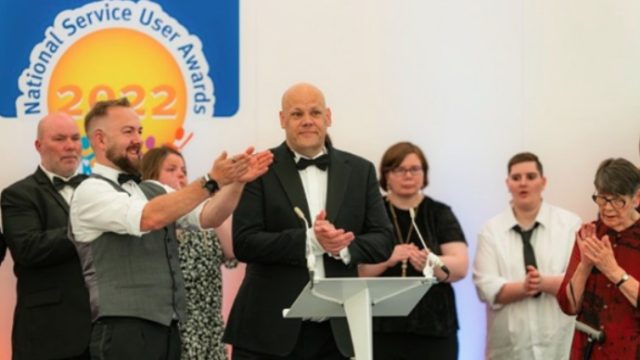
As an ex-offender, Mark wanted to return to Doncaster Prison to deliver his presentation and share his experience with the current inmates. Disappointingly this has not yet happened, as he was told by Prison Officers that ‘’there was no issue with self-harm there.’’ Which Mark knows is not the case. After hearing Mark speak, his friend nominated him to deliver his presentation at the 2022 National Service Users Awards. Under the category: Breaking Down Barriers, Mark’s presentation was titled ‘Self Harm: My Journey Calder Ward- Cheswold Park Hospital, Riverside Healthcare Ltd.’ Despite their being competition, Mark felt a strong sense of determination to deliver his presentation and to share his experience with the people attending the awards. This is a huge contrast to the periods in Mark’s life when he felt isolated and misunderstood by society.
Mark’s outlook on life at present, reinstates his beliefs that you can recover from self-harm, that there are key aspects to identify and help self-harmers change their mindset. Mark has not self-harmed in the past seven years, and he can proudly admit that his behaviour both physically and mentally has developed. Mark’s self-harm presentation was the project that won the Service User Choice Vote at the 2022 awards. Since then, Mark has continued to attend support groups, such as those offered at Sheffield Flourish, and continues to make a positive impact on those around him in his community. He also says that the hospital that he currently resides in helped put him on the map and he feels he has made great changes through their support.
One of Mark’s strongest beliefs is that he is a survivor, and not a victim. Rather than seeing himself as someone who has suffered in life, despite that being true, he has an active empowerment to no longer be defined by his past experiences. And that brings us to where Mark is today. Mark is currently writing an autobiographical novel which he hopes to be published soon. He hopes to get an agent to help him find work opportunities, and finally he wants to continue spreading the message about self-harm.
In the words of Mark himself: ‘Tough times never last, but tough people do.’
Written by Harvey Higgins. Written for Mark Leadwood